NTNU High School Students Win Gold at Silicon Valley Invention Exhibition, Also Receive People's Choice Award
Have you ever wondered what would happen if those super boring physics formulas and chemical reactions in textbooks could "move"?
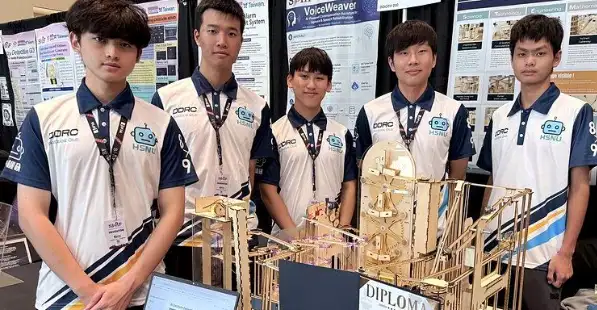
A group of senior students from the Affiliated Senior High School of National Taiwan Normal University's Machine Research Club turned projectile motion and lever principles into a "ball-bearing learning platform." They even took it to the U.S. and participated in the Silicon Valley International Invention Festival (SVIIF)! The result was amazing—they not only won a gold medal but also the only "Audience Choice Award - Young Innovator" in the youth division. It really brought knowledge to life.
That ball-bearing device looks like a mini amusement park, but it's actually full of textbook knowledge. Senior Lin Yu-cheng said that because formulas and charts are too abstract to understand, they thought they might as well build it themselves to see.
The work was designed by themselves and made with laser cutting. The trajectory of the steel ball rolling past is projectile motion, and the lever swings along with the ball. The coolest part is the chemistry level! Acetic acid and baking soda produce carbon dioxide, which then triggers a sensor to open a gate. It also incorporates a PID algorithm, connecting physics, chemistry, math, and engineering all on one track—super impressive!
Funny enough, Lin Yu-cheng said he actually used to "dislike physics quite a bit." But after making the knowledge into a physical project, seeing the ball actually fly and land, he suddenly understood how the formula predicts the landing point. Now he's actually very interested in physics. He even let his younger brother, who is learning levers in elementary school, try it. After listening to the explanation, his brother also said that this kind of "visible science" is more fun.
Their advisor, Teacher Dong Ren-yu, also said that in regular classes, they have to rush through the curriculum and prepare for exams, so it's hard to really apply things. But by doing it themselves, they can truly digest the knowledge. And at the exhibition, there are many variables; they had to measure, find causes, and adjust parameters themselves—that's how you test whether you've really learned.
This idea of "visualizing knowledge" was really useful at the Silicon Valley event. A 10-something-year-old American kid saw their work, then came back with friends and family, and even took the initiative to help introduce it and campaign for votes! Many kids who saw it made connections to things they had learned in their own classes.
This was also the first time the Machine Research Club competed abroad. For these seniors who are about to face the college entrance exam, what they brought back is more than just medals. Chen Yi-li feels that life is not just about exams and has started thinking about studying abroad in the future; Chiang Yu-che heard from the alumni studying in the U.S. and also wants to see the world; Tien Chien-hung treasures this cross-national exchange opportunity; Sun Jui-tse has started thinking about the lifestyle he likes; Lin Yu-cheng was attracted by the innovative atmosphere of Silicon Valley and now has a clearer direction for the future.
It feels like they are no longer just studying, but actually experiencing life!